Soldato morente
(traduzione di Gio Batta Bucciol, in «Poesia. Rivista internazionale di cultura poetica», 329, 2017, 8)
Capitano, portami qui il tribunale di guerra!
Io non muoio per l’imperatore!
Capitano, sei il furfante dell’imperatore!
Quando sarò morto, non farò il saluto militare!
Quando sarò dal mio Signore,
sotto di me si troverà il trono dell’imperatore,
e mi farò beffe degli ordini suoi!
Dov’è il mio paese? Lì gioca il mio bambino.
Quando mi addormenterò nel mio Signore,
arriverà l’ultima mia lettera dal campo.
Gridava, gridava, senza scampo!
Oh com’è profondo il mio amore!
Capitano, sei fuor di senno,
perché mi hai spedito qui.
Nel fuoco si è bruciato il mio cuore.
E io non muoio per nessuna patria!
Voi non mi piegate, non mi piegate!
Ecco, come la morte le catene ha spezzate!
Davanti al tribunale portate la morte!
Io muoio, ma non per l’imperatore!
Der sterbende Soldat
Hauptmann, hol her das Standgericht!
Ich sterb′ für keinen Kaiser nicht!
Hauptmann, du bist des Kaisers Wicht!
Bin tot ich, salutier′ ich nicht!
Wenn ich bei meinem Herren wohn′,
ist unter mir des Kaisers Thron,
und hab′ für sein Geheiß nur Hohn!
Wo ist mein Dorf? Dort spielt mein Sohn.
Wenn ich in meinem Herrn entschlief,
kommt an mein letzter Feldpostbrief.
Es rief, es rief, es rief, es rief!
Oh, wie ist meine Liebe tief!
Hauptmann, du bist nicht bei Verstand,
daß du mich hast hierher gesandt.
Im Feuer ist mein Herz verbrannt.
Ich sterbe für kein Vaterland!
Ihr zwingt mich nicht, ihr zwingt mich nicht!
Seht, wie der Tod die Fessel bricht!
So stellt den Tod vors Standgericht!
Ich sterb′, doch für den Kaiser nicht.
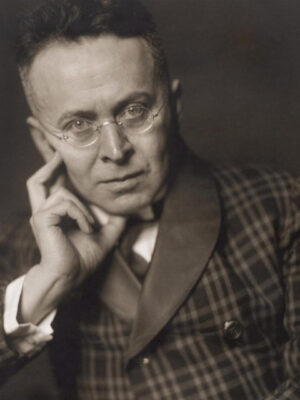
13. Karl Kraus (1874-1936) was one of the most influential intellectuals of early 20th-century Vienna. A Jew of Bohemian origins, he studied in the Austrian capital, actively frequenting the city’s literary circles. Between 1899 and 1936, he edited Die Fackel (The Torch), a magazine largely written by his own hand, from whose pages he vehemently criticized Austrian society and the intellectual scene of the time. The primary targets of his polemical activity were the bourgeois press, the decay of language, and warmongering rhetoric. He wrote numerous poems, collected in various editions of Worte in Versen, but his best-known works remain The Last Days of Mankind (1920), a monumental satirical drama about the First World War, and Third Walpurgis Night (1933), a fierce pamphlet against Nazism, published posthumously in 1952.
Soldato morente (Dying Soldier) is among the poems written by Kraus before and during the war. Kraus was opposed both to the war and to the warmongering propaganda found in the newspapers of that period. In his texts, his polemic is evident both against those who caused the conflict and against those who supported it and profited from it.

